 Free U.S. Shipping · 30-Day Money-Back Guarantee · Created by pickleball players, made for pickleball players
Pickleball Elbow: Why It Happens & How Pickle Armor™ Stops It
A players' guide to lateral epicondylitis, raw-carbon paddle vibration, and the anti-vibration brace system engineered to keep you on the court.
What Is Pickleball Elbow?
Pickleball elbow is the player's term for lateral epicondylitis - the same overuse tendon injury commonly called tennis elbow. It produces sharp pain on the outside of the elbow, weakened grip, and a burning ache that can linger for weeks after a session.
When a rigid paddle strikes a hard plastic ball, a high-frequency vibrational shock is generated at impact. With modern raw carbon paddles, that vibration transfers from the paddle face into the wrist, travels through the forearm muscles, and concentrates at the elbow joint - placing repeated stress on the extensor tendons that control wrist extension.
Common pickleball elbow symptoms from this repeated micro-trauma:
- Tendon inflammation and tenderness on the outer elbow
- Degenerative tendon changes (tendinosis) over time
- Chronic pain, weak grip, and reduced playing capacity
How Pickle Armor™ Treats & Prevents Pickleball Elbow
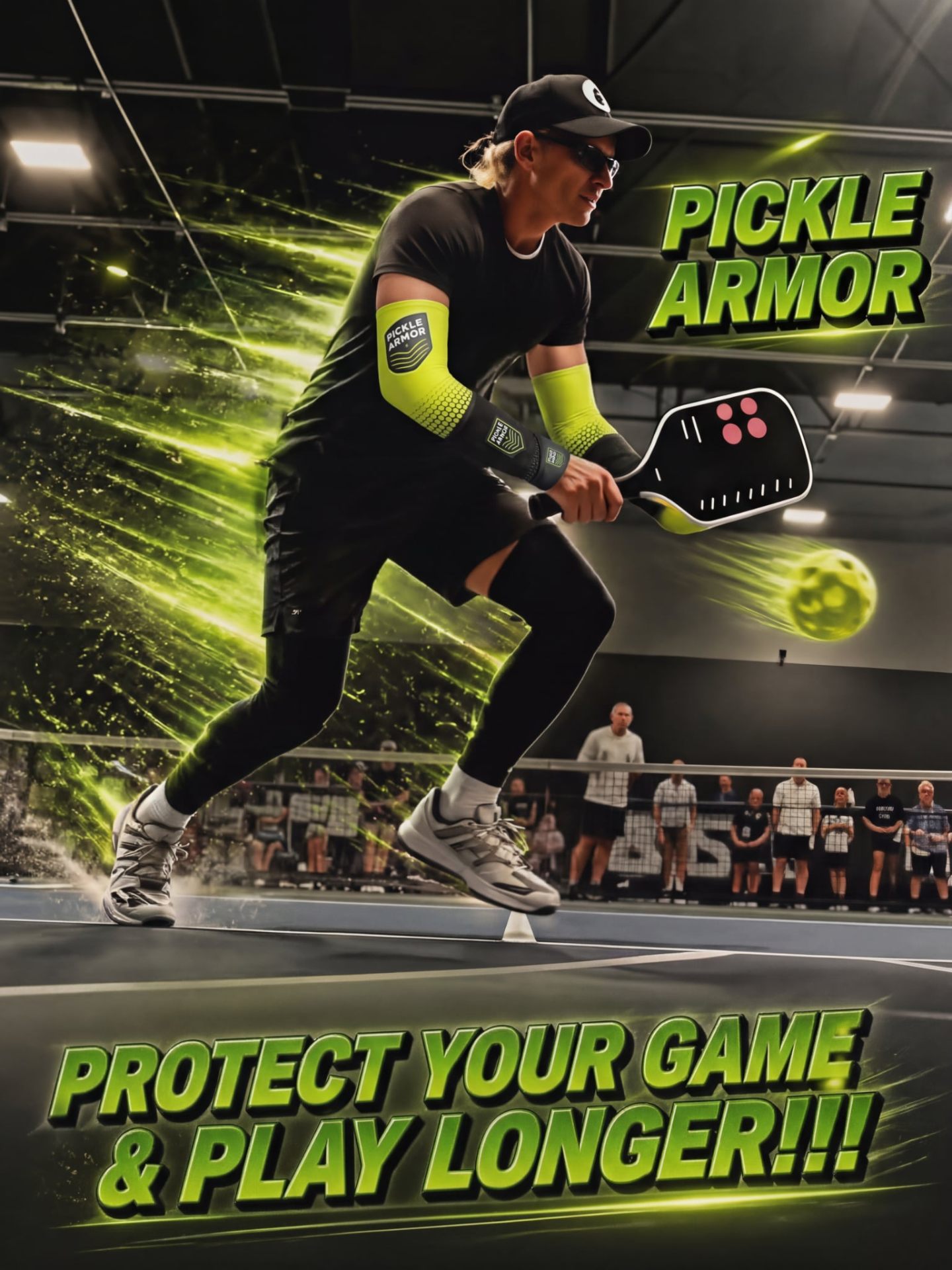
Pickle Armor is a complete 5-piece anti-vibration system - created by pickleball players, made for pickleball players - that combines:
- A stabilizing wrist brace
- A purpose-built forearm brace with integrated gel pressure pad inserts
- KT tape for targeted tendon support
- Two compression sleeves so you always have a clean one ready
The system functions as a mechanical shock absorber for the arm by:
- Dampening high-frequency vibration at the wrist and forearm level
- Applying targeted pressure to the forearm muscle bellies
- Reducing tensile load on the elbow tendons
By absorbing and dispersing vibration before it reaches the elbow, PickleArmor helps:
- Decrease stress on inflamed tendons
- Reduce pain associated with lateral epicondylitis
- Limit vibration transfer to the shoulder, reducing secondary strain
The result is less cumulative tissue damage and improved comfort during extended play.
Frequently Asked Questions
What's the actual mechanism behind Pickle Armor's anti-vibration design?+
The wrist module rigidifies the radiocarpal joint so vibration can't pivot freely into the forearm, while the forearm module uses targeted gel pressure pads over the extensor muscle bellies to absorb the remaining oscillation as heat instead of letting it travel as strain to the lateral epicondyle.
Why do raw carbon paddles aggravate elbow tendons more than older paddles?+
Raw carbon faces are stiffer and lighter, which produces a sharper, higher-frequency vibration spike at ball impact. The arm's soft tissues damp low frequencies well but absorb these high-frequency spikes much less efficiently - which is why elbow complaints have spiked alongside the rise of carbon paddles.
Is the system based on any clinical principles?+
Yes. The system draws on standard sports-medicine treatment for lateral epicondylitis: proximal counterforce bracing on the forearm to off-load the tendon insertion, wrist stabilization to limit aggravating dorsiflexion under load, plus KT taping and compression sleeves used in clinical recovery protocols.
Does it help players who also play tennis or platform tennis?+
The same biomechanics apply. Any paddle or racket sport that produces repetitive vibration at the wrist benefits from the same dampening principle, so tennis, padel, and platform-tennis players with similar elbow symptoms can use it.
See the full FAQ for more.
Watch: Pickle Armor explained
A short overview of the system and the science behind it.
See more on the videos page and read player testimonials.